


Single-Day Field Trips
bring your students for a half- or full day experience
bring your students for a half- or full day experience
bring your students for a half- or full day experience
While a multi-day program is an ideal excursion for students to break away from media and other distractions of modern life, it is not always an option for all school or class situations. Sly Park Staff work with teachers to schedule and plan a four- or six-hour experience in nature. These trips are tailored to both the grade level and emphasis of study the teacher wants.
SCHEDULING A TRIP
Like our residential program, day-trips operate on a traditional school schedule. You are welcome to book a day-trip most weeks Tuesday, Wednesday, and Thursday [Mondays arnd Fridays are not available].
While you may schedule to attend anytime throughout the standard school year, winter months often have snowy conditions that can delay transportation to the point of cancellation. Our delightful office staff will assist you in finding the perfect date.
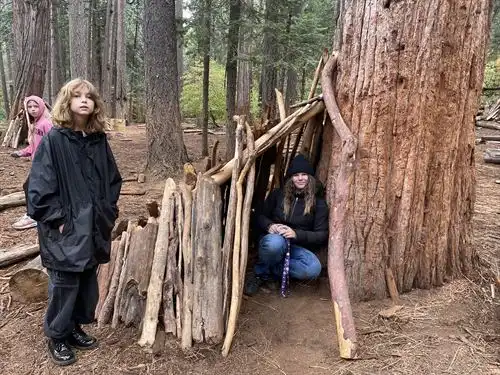
How to choose your adventure
How to choose your adventure
How to choose your adventure
It is best to begin with your goal for your class visit. Are you wanting:
- exposure to the natural world?
- team building?
- specific science standard teaching?exposure to Sly Park (often groups begin with a day trip to show the district & parents how AMAZING Sly Park is)?
- something else?
Once you have a goal, check out our activities page and see what appeals to you and might meet your goal or goals. The biggest constraint is generally time. The more activities scheduled into your time, the less depth available for each activity. Generally, even with the 5-day programs, people leave wanting more!
A Sly Park Staff member will assist you in finalizing your choices 4-6 weeks before your visit (or earlier if you prefer).
4-hour sly park experience
4-hour sly park experience
4-hour sly park experience
A 4-hour visit usually can accommodate two activities from our list, or one nice long Park Creek experience.
Students bring a sack lunch and eat before departing for the day.
6-hour sly park experience
6-hour sly park experience
6-hour sly park experience
A 6-hour visit usually can accommodate three activities from our list or two and Park Creek.
Students bring a sack lunch and usually eat midway through the visit.
Click on the tab for NGSS of each grade...if your grade is not listed, please check back
Click on the tab for NGSS of each grade...if your grade is not listed, please check back
Third Grade
NGSS Organized by DCI (3rd grade) and Corresponding Sly Park Activities
| NGSS | PERFORMANCE EXPECTATIONS | DISCIPLINARY CORE IDEAS | RELEVANT SLY PARK ACTIVITIES |
| 3-LS1 From Molecules to Organisms: Structures and Processes | 3-LS1-1. Develop models to describe that organisms have unique and diverse life cycles but all have in common birth, growth, reproduction, and death. | LS1.B: Growth and Development of Organisms |
|
| 3-LS2 Ecosystems: Interactions, Energy, and Dynamics | 3-LS2-1. Construct an argument that some animals form groups that help members survive. |
LS2.D: Social Interactions and Group Behavior
|
|
| 3-LS3 Heredity: Inheritance and Variation of Traits |
3-LS3-1. Analyze and interpret data to provide evidence that plants and animals have traits inherited from parents and that variation of these traits exists in a group of similar organisms.
3-LS3-2. Use evidence to support the explanation that traits can be influenced by the environment.
|
LS3.A: Inheritance of Traits Many characteristics of organisms are inherited from their parents.
LS3.B: Variation of Traits
|
|
| 3-LS4 Biological Evolution: Unity and Diversity |
3-LS4-2. Use evidence to construct an explanation for how the variations in characteristics among individuals of the same species may provide advantages in surviving, finding mates, and reproducing.
3-LS4-3. Construct an argument with evidence that in a particular habitat some organisms can survive well, some survive less well, and some cannot survive at all.
3-LS4-4. Make a claim about the merit of a solution to a problem caused when the environment changes and the types of plants and animals that live there may change.*
|
LS2.C: Ecosystem Dynamics, Functioning, and Resilience
LS4.A: Evidence of Common Ancestry and Diversity
LS4.B: Natural Selection
LS4.C: Adaptation
LS4.D: Biodiversity and Humans
|
|
| 3-ESS2 Earth’s Systems | 3-ESS2-2. Obtain and combine information to describe climates in different regions of the world. | ESS2.D: Weather and Climate |
|
| 3-ESS3 Earth and Human Activity | 3-ESS3-1. Make a claim about the merit of a design solution that reduces the impacts of a weather-related hazard.* | ESS3.B: Natural Hazards |
|
| 3-PS2 Motion and Stability: Forces and Interactions |
3-PS2-2. Make observations and/or measurements of an object’s motion to provide evidence that a pattern can be used to predict future motion.
|
PS2.A: Forces and Motion |
|
| 3–5-ETS1 Engineering Design | 3–5-ETS1-1. Define a simple design problem reflecting a need or a want that includes specified criteria for success and constraints on materials, time, or cost. 3–5-ETS1-2. Generate and compare multiple possible solutions to a problem based on how well each is likely to meet the criteria and constraints of the problem. |
ETS1.A: Defining and Delimiting Engineering Problems
ETS1.B: Developing Possible Solutions
|
|
5th Grade
NGSS Organized by DCI (5th grade) and Corresponding Sly Park Activities
| NGSS | PERFORMANCE EXPECTATIONS | DISCIPLINARY CORE IDEAS | RELEVANT SLY PARK ACTIVITIES |
|
5-PS2
Motion and Stability: Forces and Interactions
|
5-PS2-1. Support an argument that the gravitational force exerted by Earth on objects is directed down. | PS2.B: Types of Interactions |
|
|
5-PS3
Energy
|
5-PS3-1. Use models to describe that energy in animals’ food (used for body repair, growth, motion, and to maintain body warmth) was once energy from the sun.
|
PS3.D: Energy in Chemical Processes and Everyday Life LS1.C: Organization for Matter and Energy Flow in Organisms
|
|
|
5-LS1
From Molecules to Organisms: Structures and Processes
|
5-LS1-1. Support an argument that plants get the materials they need for growth chiefly from air and water. | LS1.C: Organization for Matter and Energy Flow in Organisms |
|
| 5-LS2 Ecosystems: Interactions, Energy, and Dynamics | 5-LS2-1. Develop a model to describe the movement of matter among plants, animals, decomposers, and the environment. | LS2.A: Interdependent Relationships in Ecosystems LS2.B: Cycles of Matter and Energy Transfer in Ecosystems |
|
|
5-ESS1
Earth’s Place in the Universe
|
5-ESS1-1. Support an argument that differences in the apparent brightness of the sun compared to other stars is due to their relative distances from Earth. 5-ESS1-2. Represent data in graphical displays to reveal patterns of daily changes in length and direction of shadows, day and night, and the seasonal appearance of some stars in the night sky |
ESS1.A: The Universe and its Stars
ESS1.B: Earth and the Solar System
|
|
|
5-ESS2
Earth’s Systems
|
5-ESS2-1. Develop a model using an example to describe ways the geosphere, biosphere, hydrosphere, and/or atmosphere interact. |
ESS2.A: Earth Materials and Systems
ESS2.C: The Roles of Water in Earth’s Surface Processes
|
|
|
5-ESS3
Earth and Human Activity
|
5-ESS3-1. Obtain and combine information about ways individual communities use science ideas to protect the Earth’s resources and environment. | ESS3.C: Human Impacts on Earth Systems |
|
| 3-5-ETS1 Engineering Design |
3-5-ETS1-1. Define a simple design problem reflecting a need or a want that includes specified criteria for success and constraints on materials, time, or cost.
3-5-ETS1-2. Generate and compare multiple possible solutions to a problem based on how well each is likely to meet the criteria and constraints of the problem.
3-5-ETS1-3. Plan and carry out fair tests in which variables are controlled and failure points are considered to identify aspects of a model or prototype that can be improved.
|
ETS1.A: Defining and Delimiting Engineering Problems
ETS1.B: Developing Possible Solutions
ETS1.C: Optimizing the Design Solution
|
|
Middle School (6-8)
NGSS Organized by DCI (middle school) and Corresponding Sly Park Activities
| NGSS | PERFORMANCE EXPECTATIONS | DISCIPLINARY CORE IDEAS | RELEVANT SLY PARK ACTIVITIES |
|
MS-PS2
Motion and Stability: Forces and Interactions
|
MS-PS2-4. Construct and present arguments using evidence to support the claim that gravitational interactions are attractive and depend on the masses of interacting objects. |
PS2.A: Forces and Motion PS2.B: Types of Interactions
|
|
|
MS-PS3
Energy
|
MS-PS3-3. Apply scientific principles to design, construct, and test a device that either minimizes or maximizes thermal energy transfer.* |
PS3.A: Definitions of Energy PS3.B: Conservation of Energy and Energy Transfer
ETS1.B: Developing Possible Solutions
|
|
|
MS-LS1
From Molecules to Organisms:
Structures and Processes
|
MS-LS1-4. Use argument based on empirical evidence and scientific reasoning to support an explanation for how characteristic animal behaviors and specialized plant structures affect the probability of successful reproduction of animals and plants respectively.
MS-LS1-5. Construct a scientific explanation based on evidence for how environmental and genetic factors influence the growth of organisms.
MS-LS1-6. Construct a scientific explanation based on evidence for the role of photosynthesis in the cycling of matter and flow of energy into and out of organisms.
|
LS1.A: Structure and Function
LS1.B: Growth and Development of Organisms
LS1.C: Organization for Matter and Energy Flow in Organisms
PS3.D: Energy in Chemical Processes and Everyday Life
|
|
| MS-LS2 Ecosystems: Interactions, Energy, and Dynamics |
MS-LS2-1. Analyze and interpret data to provide evidence for the effects of resource availability on organisms and populations of organisms in an ecosystem.
MS-LS2-2. Construct an explanation that predicts patterns of interactions among organisms across multiple ecosystems.
MS-LS2-3. Develop a model to describe the cycling of matter and flow of energy among living and nonliving parts of an ecosystem.
MS-LS2-4. Construct an argument supported by empirical evidence that changes to physical or biological components of an ecosystem affect populations.
|
LS2.A: Interdependent Relationships in Ecosystems
LS2.B: Cycle of Matter and Energy Transfer in Ecosystems
LS2.C: Ecosystem Dynamics, Functioning, and Resilience
LS4.D: Biodiversity and Humans
ETS1.B: Developing Possible Solutions
|
|
|
MS-LS4
Biological Evolution:
Unity and Diversity
|
MS-LS4-2. Apply scientific ideas to construct an explanation for the anatomical similarities and differences among modern organisms and between modern and fossil organisms to infer evolutionary relationships. |
LS4.A: Evidence of Common Ancestry and Diversity
LS4.B: Natural Selection
LS4.C: Adaptation
|
|
|
MS-ESS1
Earth’s Place in the Universe
|
MS-ESS1-1. Develop and
use a model of the Earth-sun-moon system to describe the cyclic patterns of lunar phases, eclipses of the sun and moon, and seasons. MS-ESS1-3. Analyze and interpret data to determine scale properties of objects in the solar system.
|
ESS1.A: The Universe and Its Stars
ESS1.B: Earth and the Solar System
|
|
|
MS-ESS2
Earth’s Systems
|
MS-ESS2-4. Develop a model to describe the cycling of water through Earth’s systems driven by energy from the sun and the force of gravity. |
ESS2.A: Earth’s Materials and Systems ESS2.C: The Roles of Water in Earth’s Surface Processes
ESS2.D: Weather and Climate
|
|
|
MS-ESS3
Earth and Human Activity
|
MS-ESS3-2. Analyze and interpret data on natural hazards to forecast future catastrophic events and inform the development of technologies to mitigate their effects.MS-ESS3-4. Construct an argument supported by evidence for how increases in human population and per-capita consumption of natural resources impact Earth’s systems.
MS-ESS3-5. Ask questions to clarify evidence of the factors that have caused the rise in global temperatures over the past century.
|
ESS3.A: Natural Resources
ESS3.B: Natural Hazards
ESS3.C: Human Impacts on Earth Systems
ESS3.D: Global Climate Change
|
|
| MS-ETS1 Engineering Design | MS-ETS1-1. Define the criteria and constraints of a design problem with sufficient precision to ensure a successful solution, taking into account relevant scientific principles and potential impacts on people and the natural environment that may limit possible solutions. MS-ETS1-2. Evaluate competing design solutions using a systematic process to determine how well they meet the criteria and constraints of the problem. |
ETS1.A: Defining and Delimiting Engineering Problems
ETS1.B: Developing Possible Solutions ETS1.C: Optimizing the Design Solution
|
|


